
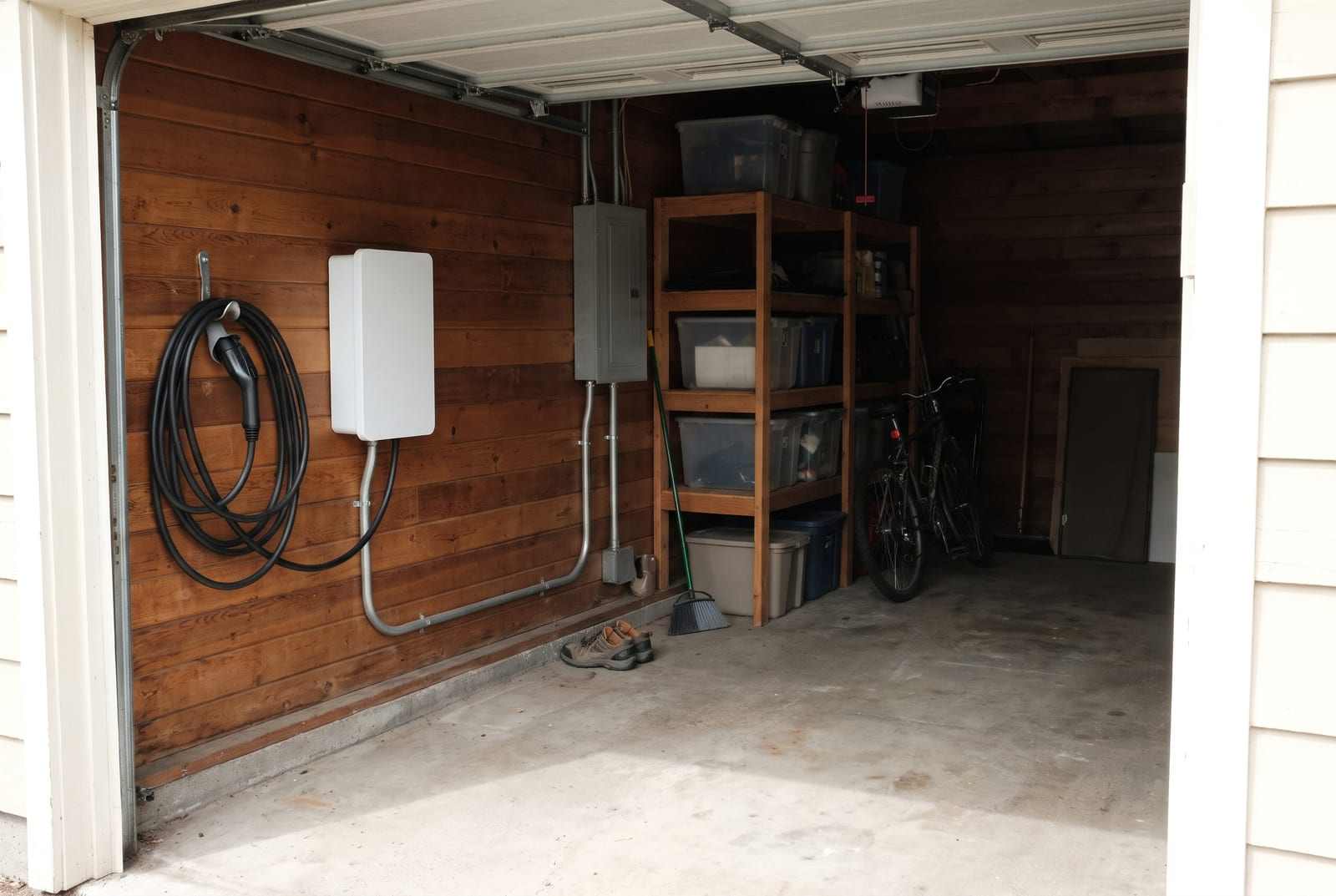
EV Chargers
A charger is a simple device on a demanding circuit. It draws near its limit for hours at a time, so the wire, the connections and the panel behind it have to be right.
We add the circuit, mount and connect the charger, and test it under load. The same work applies to a garage, a carport, a condo stall or a row of spaces behind a shop.
Charging Levels
Scroll right for the other columns.
| Level | Voltage | Connection type | Typical use | Installation notes |
|---|---|---|---|---|
| Level 1 | 120 volts | The car’s own cord in a standard outlet | Short commutes, plug-in hybrids, overnight top-ups | Best on a circuit of its own with an outlet in good condition; an old, loose outlet can overheat |
| Level 2 plug-in | 240 volts | A charger plugged into a 14-50 or 6-50 receptacle | Daily driving, a charger you may take with you | An industrial-grade receptacle and GFCI protection; output limited by the receptacle |
| Level 2 hardwired | 240 volts, or 208 in many shops and offices | The charger wired straight to its circuit | Outdoor spots, higher output, shared or workplace parking | No plug to wear out; the circuit is sized at 125 percent of the charger’s output |
Before a Charger Installation
- Find the panel and read the main breaker’s number; a photo of the panel’s label helps too.
- Measure, roughly, the way a wire would run from the panel to the parking spot. Distance and the kind of wall decide much of the work.
- Check which charging port the car has, and which connector the charger comes with.
- In a rental or a condo, ask the landlord or the association first, in writing. California law gives many residents a way to request a charger.
- Decide between indoor and outdoor mounting, and where the cable will hang when nobody is charging.
- Think about a second car. Running a larger conduit now is easier than opening the wall twice.
Sizing the Circuit
Charging counts as a continuous load, so the circuit must be rated at 125 percent of what the charger draws. A 32-amp charger takes a 40-amp circuit, a 40-amp charger a 50-amp circuit, a 48-amp charger a 60-amp circuit. Many chargers can be set lower at installation, which is the simplest way to fit one into a service with little room. When the service itself is the limit, the answer is load management or a panel upgrade.
Wall chargers last longest when the cable hangs off the floor and the unit is mounted at chest height, away from garage doors and bins.
Chargers at Work and in Shared Parking
Several chargers on one service can share power, so that ten cars do not need ten full circuits. Accessible spaces, lighting, protection posts and the meter that pays for the power all belong in the plan. For shops, offices and apartment buildings, see commercial electrical work.
Panels, Permits and Outdoor Chargers
Can my home’s panel support a charger?
A load calculation answers it. A 40-amp charger circuit fits in many 200-amp services without other changes. In a 100-amp service with electric cooking or air conditioning it often does not, and then the choices are a lower charging rate, a load management device, or a larger panel.
Do I need a permit for a charger?
A new 240-volt circuit needs an electrical permit and an inspection. Cities in California offer a streamlined process for home chargers, and the paperwork usually asks for the charger’s rating and a load calculation. In a condo, the association’s approval comes before the permit.
Can the charger go outside?
Yes, if the unit is rated for outdoor use. It needs a weatherproof connection, and near the coast a hardwired unit in a sealed enclosure resists salt air better than a plug and receptacle. Shade helps as well: electronics run cooler out of afternoon sun.
How fast will the car charge?
It depends on the smaller of two numbers: what the circuit allows and what the car’s onboard charger accepts. A 40-amp circuit delivers up to 32 amps of continuous charging, about 7.7 kilowatts at 240 volts.